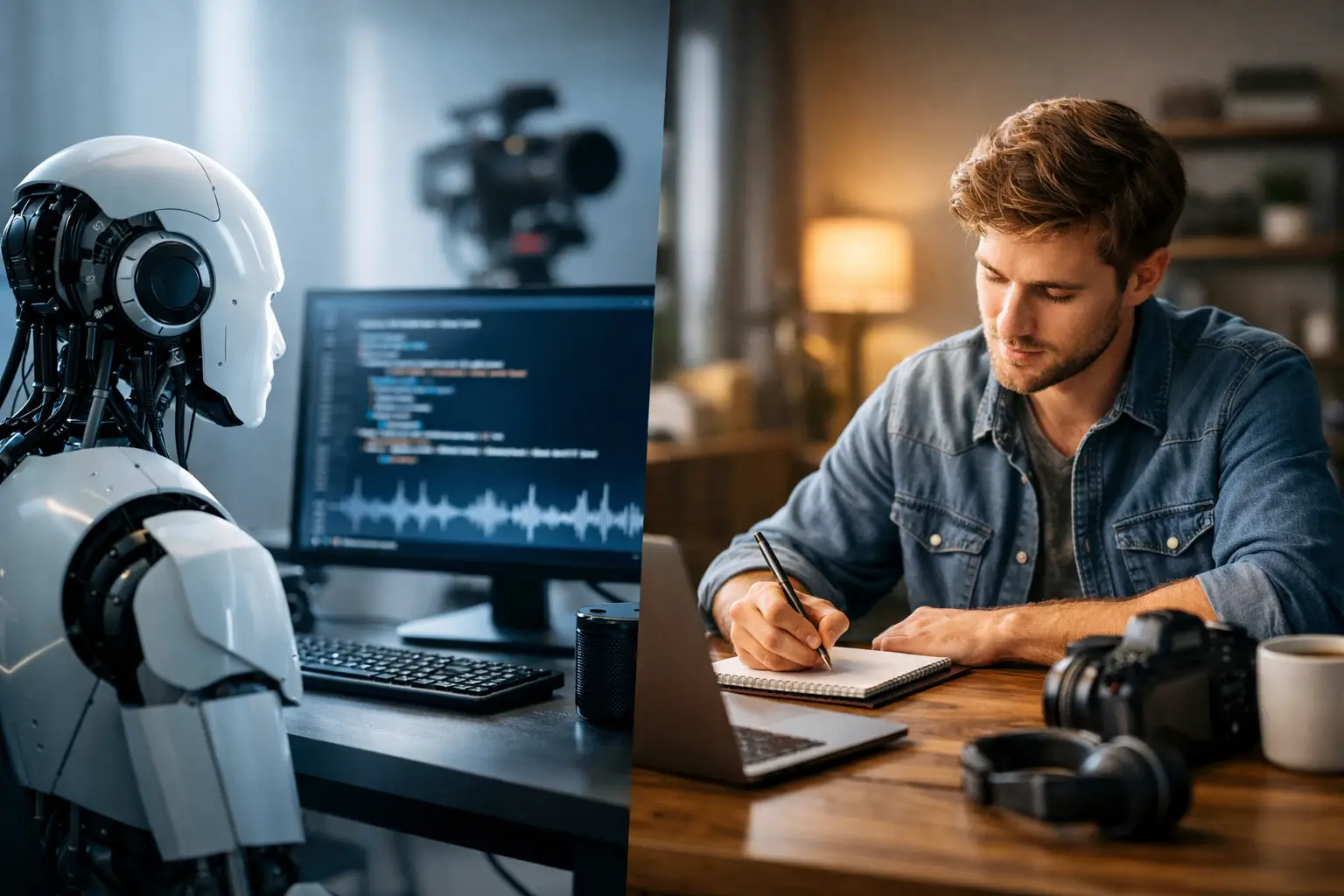
A documentary channel can lose momentum in the gap between a good idea and a finished upload. Research takes hours. Scripts need structure. Voiceovers, visuals, thumbnails, and metadata each create another handoff. That is why the debate around AI scripts versus writers is not really about whether machines can write a sentence. It is about which production system helps creators publish more high-quality videos without turning every upload into a week-long project.
For faceless YouTube channels, solo operators, and small teams, the strongest answer is rarely “AI only” or “human only.” It is knowing which parts of documentary production demand speed and scale, and which parts still benefit from human direction.
AI Scripts Versus Writers: The Real Comparison
A professional writer brings perspective, instinct, and the ability to make an audience feel something. They can spot a weak premise, find a surprising angle, and shape a complicated topic around a clear central idea. When a video depends on an original thesis, a distinctive point of view, or sensitive editorial judgment, that level of human involvement matters.
But writing is only one part of producing a YouTube documentary. A finished upload also needs topic research, an organized narrative, fact checks, citations, narration, a visual plan, background music, a thumbnail, and SEO metadata. Even a talented writer does not automatically solve the rest of that workflow.
AI changes the equation because it can turn a topic into a complete production package at a speed that is difficult to match manually. Instead of opening six tools and coordinating freelancers, a creator can move from idea to a fact-grounded script, voiceover, storyboard-based video, thumbnail, sources, and publishing assets in one process.
The question is not whether AI can replace every writer in every circumstance. It cannot. The better question is whether a creator needs a one-off custom script or a repeatable system built to publish consistently.
Where AI Scripts Create a Clear Advantage
Speed is the most obvious advantage, but it is not the only one. A creator working alone may have enough ideas for fifty videos but only enough time to finish four. AI-assisted production reduces the bottleneck between concept and publication.
For educational documentaries, AI can rapidly organize broad subjects into a logical story. A topic such as the fall of an empire, the science behind a natural disaster, or the rise of a global industry needs a beginning, tension, context, and payoff. A well-designed documentary workflow can structure those elements before the creator spends days staring at a blank page.
Consistency is just as valuable. YouTube channels grow when viewers know what to expect. That does not mean every video should sound identical. It means the channel should maintain a dependable standard for pacing, narration, visual quality, and packaging. AI can help creators apply a consistent format across a larger catalog while leaving room to tailor the hook, angle, and final edit.
Cost also matters. Hiring a writer, researcher, voice artist, editor, and thumbnail designer for every documentary can make high-volume publishing expensive quickly. For a new channel, that cost often delays the very testing needed to find winning topics. Automated production lets creators test more ideas, learn faster from audience response, and invest human budget where it creates the biggest difference.
Where Human Writers Still Win
There are situations where a human writer is the better choice. If your channel relies on a recognizable personal voice, original reporting, interviews, investigative work, or strong commentary, a writer can bring judgment that a standard generation workflow cannot fully reproduce.
Humans are also better at navigating ambiguity. A writer who knows your audience may recognize that a topic is technically interesting but emotionally flat. They may find the provocative question that turns a basic history lesson into a video viewers want to click and discuss.
This matters especially for channels building a premium editorial brand. If every video is meant to feel like a flagship production, slower custom writing can be a sensible investment. The same is true for subjects involving legal risk, medical advice, current events, or controversial claims. AI-generated material should be reviewed carefully, and factual sources should never be treated as optional.
The trade-off is capacity. A human-led process usually produces fewer videos, requires more project management, and becomes harder to scale without a team. That may be fine for a channel focused on one major release each month. It is less practical for creators trying to build a searchable library across multiple educational niches.
The Best Workflow Is Often AI First, Creator Directed
The most effective creators do not use AI to avoid thinking. They use it to stop wasting time on repetitive production work.
Start with the strategic decision a human should own: the channel niche, target viewer, topic angle, and desired outcome. Decide whether the video should inform, surprise, inspire, or challenge assumptions. Then use AI to generate the foundational assets quickly - the verified script structure, professional narration, visual sequence, thumbnail direction, and full SEO suite.
From there, apply human review where it has the highest leverage. Tighten the opening hook. Remove claims that need stronger support. Add a fresh angle that fits your channel. Check names, dates, and citations. Make sure the title and thumbnail promise the same experience the video delivers.
That process protects quality without rebuilding every asset from scratch. It also gives creators a realistic way to scale. You are not choosing between an automated content factory and a painstaking custom production. You are building a system where automation handles volume and the creator controls standards.
What YouTube Audiences Actually Care About
Viewers do not usually reward a video because a human wrote every word. They reward videos that answer a compelling question, hold attention, look credible, and deliver on the click.
A polished script with no visual pacing can still lose viewers. A beautiful edit with an unfocused narrative can lose them too. Documentary performance comes from the complete package: a topic with demand, a clear hook, trustworthy information, natural narration, coherent visuals, and metadata that helps the right audience find it.
That is why comparing an AI script directly to a writer can be misleading. It compares one output against one role. A better comparison is between a disconnected production process and an end-to-end publishing system.
DocuViralPro is designed around that broader outcome. It helps creators turn a trend or entered topic into a viral AI documentary with fact-grounded scripts, narration, slideshow visuals, citations, thumbnails, and YouTube SEO metadata. For creators who want to work beyond factual documentary topics, the Anything category supports fictional concepts, ads, and other formats with the same streamlined production approach.
Choosing the Right Model for Your Channel
Use AI-led production when your priority is publishing frequency, topic testing, educational scale, and operational efficiency. It is especially useful when you need to build a video library, launch a faceless channel, or create multiple documentaries without managing a stack of separate tools.
Use a human writer when your competitive advantage is a rare personal voice, a complex original argument, or reporting that demands deep editorial context. In many cases, use both: let AI produce the first complete version, then bring in a writer or editor for high-stakes videos and channel-defining releases.
The deciding factor is not whether AI sounds impressive on paper. It is whether your channel can reliably turn strong topics into finished videos that earn clicks, watch time, and return viewers.
A great idea does not help a channel while it sits in a notes app. Build a production process that gets your best topics published, then use your human attention where the audience can actually feel it.