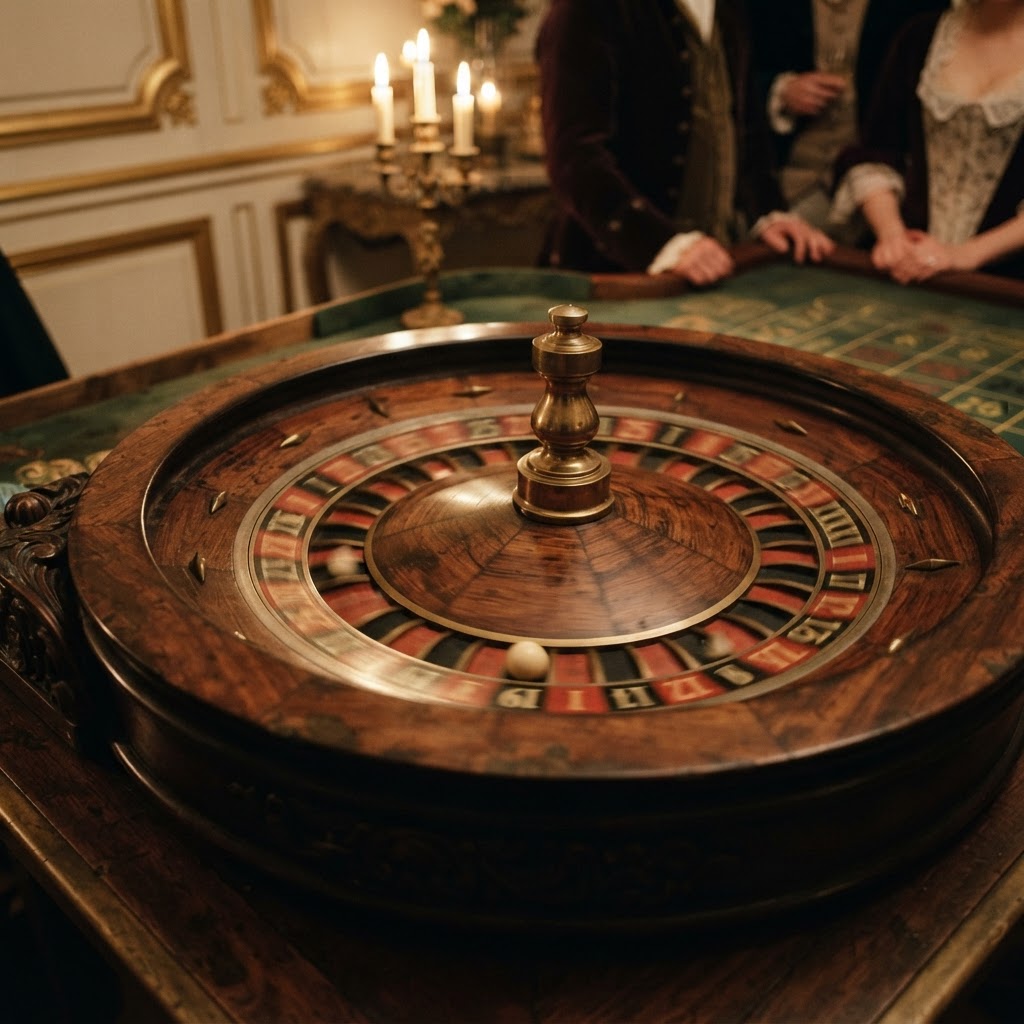
Can a device built to decode the mind of God become the instrument of our own obsession? The wheel is a mesmerizing blur of red, black, and green, a spinning circle that has captivated humanity for centuries. Yet, its origins are not found in the smoke-filled basements of shadowy underworlds or the neon-drenched floors of modern resorts. Instead, the story begins in the intellectual fervor of the seventeenth century, within the mind of a singular polymath seeking to solve the secrets of nature itself.
In 1655 , the French mathematician and philosopher Blaise Pascal [1] was not looking to start a gambling craze. He was obsessed with something far more profound: the nature of infinity and the mathematical laws of chance. Pascal was attempting to construct a perpetual motion machine [2]—a device that could theoretically run forever without an external energy source. While his mechanical efforts to cheat the laws of thermodynamics ultimately failed, the device he developed for his experiments became the unwitting ancestor of the most famous game in history. How could a failed scientific apparatus evolve into a global cultural icon? The answer lies in the intersection of rigorous probability theory and the insatiable human desire to flirt with fate.
By the middle of the eighteenth century, the elegant drawing rooms of Paris had transformed from sites of intellectual discourse into arenas of high-stakes play [3]. The social elite of France were looking for new ways to test their luck, and the mechanics developed by Pascal—a spinning wheel featuring a series of pockets—offered the perfect structure for a game of chance. Unlike the card games of the era, which relied on social deception and individual skill, the wheel was blind. It did not care about the player’s status, their intellect, or their fortune. The wheel serves as an absolute arbiter of destiny, untouched by human intent.
This was the dawn of the roulette era in 18th-century France . Aristocrats and intellectuals alike gathered around the small, spinning wooden discs. It was an age of Enlightenment, yet here they were, sacrificing their coins to a game that prioritized total randomness over logical strategy. Did they realize they were playing a game governed by the same probability mathematics that Pascal had pioneered to understand the world? Probably not. To them, the wheel was simply a captivating way to spend a night in the gilded parlors of the capital.
The game began to evolve. Initially, the wheel did not have the zero that modern players fear today. It was a simpler design, featuring numbers that allowed for a cleaner, more intuitive set of odds. But the allure of the house advantage soon became apparent to those running these private parlors. As the popularity of the game surged, so too did the sophistication of the equipment. It was no longer just a hobby; it was becoming a business model. In the halls of Paris, the simple spin of a wooden wheel decided the fortunes of an entire aristocracy.
As the century drew toward a close, the mechanics of roulette became more standardized. The introduction of the zero—and later, in some variations, the double zero—dramatically shifted the house edge [4]. This was the moment where probability theory truly met the cold reality of finance. Mathematics, the very field Pascal had helped to pioneer, was now being used to ensure that the house would almost always win over the long term. It is a striking irony that the study of random patterns, intended to illuminate the universe, resulted in a mechanism designed to extract wealth through controlled chaos.
Why do we remain so enthralled by a process that is statistically designed to deplete us? The answer, perhaps, lies in the human brain's peculiar relationship with risk. We are hardwired to look for patterns in noise, to believe that after a long streak of black, red must inevitably be the next outcome. This is the gambler’s fallacy, a cognitive bias that has fueled the roulette industry since its inception. Even in the salons of the seventeen-hundreds, players were convinced they could "crack the code" of the wheel. They kept journals, noted sequences, and treated the spinning disc as if it were a sentient opponent rather than a simple mechanical device governed by Newtonian physics.
The house maintains a mathematical advantage of approximately 5.26 percent in standard American roulette. [5] This margin, while seemingly small, represents the triumph of actuarial science over human hope. It is a testament to the power of probability that such a small edge can sustain an entire global industry for hundreds of years. The eighteenth-century gambler in Paris felt the same rush of adrenaline as the modern player, driven by the belief that the next spin would finally be the one that defied the odds.
As we look back at these early, dimly lit gaming rooms, we see the foundation of a modern obsession. The transition from Pascal’s laboratory to the private parlors of France turned a scientific curiosity into a dangerous, addictive pastime. But the story of the wheel was only just beginning. The game had successfully conquered Paris, but it was hungry for a wider audience, and the technological advancements of the coming century were about to push the wheel out of the parlor and onto the world stage. The humble beginnings of a mathematical experiment were destined to turn into an empire of chance that would soon span across continents, leaving the quiet streets of Europe for a much louder, more industrial future.
When the wheel crossed the ocean, it transformed from a European pastime into an American industrial obsession. By the middle of the nineteenth century, the game had found its way from the refined parlors of Paris into the booming, unpredictable landscape of the United States. While the French had cultivated a version of roulette that prioritized a single zero to maintain a subtle edge, American operators saw an opportunity to accelerate the house profit. They added the double zero [6], a modification that fundamentally altered the physics of the game and deepened the divide between the player and the house. This was the birth of the American-style wheel, a machine designed for speed, volatility, and high-volume turnover.
In the mid-1800s, the Blanc brothers , Louis and François, had already changed the course of history in Monte Carlo [7]. They took the game and turned it into the cornerstone of a luxury destination, crafting an experience where the architecture was as grand as the risks were high. By eliminating the double zero in their casinos, they created the gold standard of European roulette, a model that promised slightly better odds to the player, thereby drawing in the wealthiest patrons of the era. They essentially invented the modern casino destination, proving that if you make the setting opulent enough, people will gladly trade their fortunes for the mere possibility of a win.
As the game took root in the American West and beyond, it shed its velvet-draped European skin and took on a utilitarian, almost industrial quality. Casinos emerged in mining towns and bustling ports, serving as the heartbeat of frontier economies. The house is not just a participant in the game; the house is the game itself. This shift represented a broader change in how gambling was perceived globally. It moved from an aristocratic vice to a commercial enterprise, a regulated mechanism for generating revenue. The introduction of standardized, factory-produced wheels [8] meant that the game’s randomness was no longer just a theory—it was a consistent, replicable, and heavily guarded product.
This professionalization of the wheel was mirrored by a massive rise in its popularity. In the twentieth century, as the Las Vegas strip began to rise from the desert floor, the roulette wheel became a fixed, iconic fixture of the casino floor [9]. It was no longer tucked away in an intimate side room; it was placed front and center, its mechanical hum a siren song for thousands of visitors. The sheer scale of the operation was staggering. By the time the modern era arrived, the casino industry was generating tens of billions of dollars annually, with roulette standing as one of the most recognizable symbols of the entire enterprise.
Why has this specific machine endured when so many other games have faded into obscurity? Part of the answer is that the roulette wheel offers a visceral simplicity. In an age of complex, digital interfaces and inscrutable algorithms, the mechanical spinning of a physical ball into a numbered pocket remains an analog experience. It is tangible. You can see the ball hop, you can hear it rattle against the frets, and you can watch, in real-time, as the outcome is decided by nothing more than speed, momentum, and friction. It is, perhaps, the most honest game in the casino because it hides nothing from the naked eye.
Despite the rise of computers and the internet, the classic wheel has not been replaced; it has been digitized and expanded. Today, you can participate in a live stream of a spinning wheel from anywhere on the planet [10]. Yet, the core tension remains exactly the same as it was in Pascal’s study. The 2.7 percent house edge of the European wheel and the 5.26 percent house edge of the American wheel act as invisible barriers to long-term success. It is a mathematical reality that prevents the wheel from ever being truly beaten over time. We are all chasing the illusion of a lucky streak, while the wheel follows the rigid laws of probability.
The cultural legacy of roulette is vast, having inspired countless films, novels, and songs about the desperate beauty of gambling. It has become a shorthand for life itself: a spinning, uncertain path where we place our bets on the unknown. Yet, beyond the allure of the cinema, the wheel remains a reminder of our relationship with the infinite. It is a device that forces us to confront the fact that, in a world governed by cause and effect, there are moments where chance is the only true master.
The wheel has traveled from the desk of a mathematician, through the opulent halls of Monte Carlo, and into the neon heart of modern industry. It has seen the rise and fall of empires, the birth of modern economic systems, and the evolution of the very idea of luck. Every time that ivory ball begins its descent, the same tension arises—the tension between our hope for a miraculous outcome and the cold, unyielding precision of the machinery. It is a cycle that has spun for centuries, and so long as humans continue to be fascinated by the roll of the dice or the spin of a wheel, it will likely spin for many more. The game, in its essence, is a conversation with the impossible, a perpetual effort to find pattern where there is only physics.
We find ourselves constantly returning to the table, hoping that the next turn of the disc will be the one to change our story. It is a cycle that binds us to the past, reminding us of our ancestors who sat in those same dim rooms, watching the ball wobble toward a final resting place. The wheel doesn't remember, and it doesn't care, yet we give it our attention, our money, and our dreams. Whether played on a wooden table in a hidden parlor or on a screen in a crowded city, the roulette wheel remains the ultimate symbol of the unpredictable. Thank you for watching this video. If you enjoyed the content please remember to like the video, share with a friend, and subscribe to the channel. Thanks so much for your support.