A black hole is not a hole. Quantum particles can exist in multiple states. Your audience may be fascinated by both ideas, but fascination alone does not produce a watchable video. A science explainer video generator gives creators a faster way to turn difficult concepts into structured, cinematic content that viewers can understand, finish, and share.
For a faceless science channel, the real bottleneck is rarely finding a topic. There is no shortage of material in space, biology, physics, climate, medicine, or technology. The bottleneck is converting that material into a credible story with a clear hook, accurate context, engaging visuals, professional narration, and a package built for YouTube discovery.
Why science videos are hard to produce at scale
Science content asks more of a creator than a typical commentary video. You need to simplify without distorting. You need enough context for beginners, while giving knowledgeable viewers a reason to stay. And you need visual momentum even when the subject is invisible, microscopic, theoretical, or happening over millions of years.
A video about CRISPR, for example, cannot simply define gene editing and call it done. It needs to answer what changes inside a cell, why the discovery matters, where the limits are, and what could happen next. That requires research, a logical script structure, visuals that illustrate the process, and pacing that turns a lesson into a story.
Building this manually can take days. Research must be checked, scripts must be written, narration must be recorded or sourced, visuals must be assembled, music must fit the mood, and the finished upload still needs a clickable thumbnail, title, description, tags, and citations. For solo creators and small teams, that workflow caps output before the channel has a chance to build momentum.
What a science explainer video generator should create
General-purpose AI video tools can make clips, but clips are not a documentary. A useful science explainer video generator should build around the complete publishing workflow, not just produce isolated visuals.
Start with the script. The strongest science videos lead with a question, tension, or surprising fact, then move through the explanation in a sequence viewers can follow. The script should distinguish established findings from hypotheses, avoid exaggerated claims, and use clear analogies only when they improve understanding. If a topic contains genuine scientific disagreement, the video should show that nuance rather than force a false certainty.
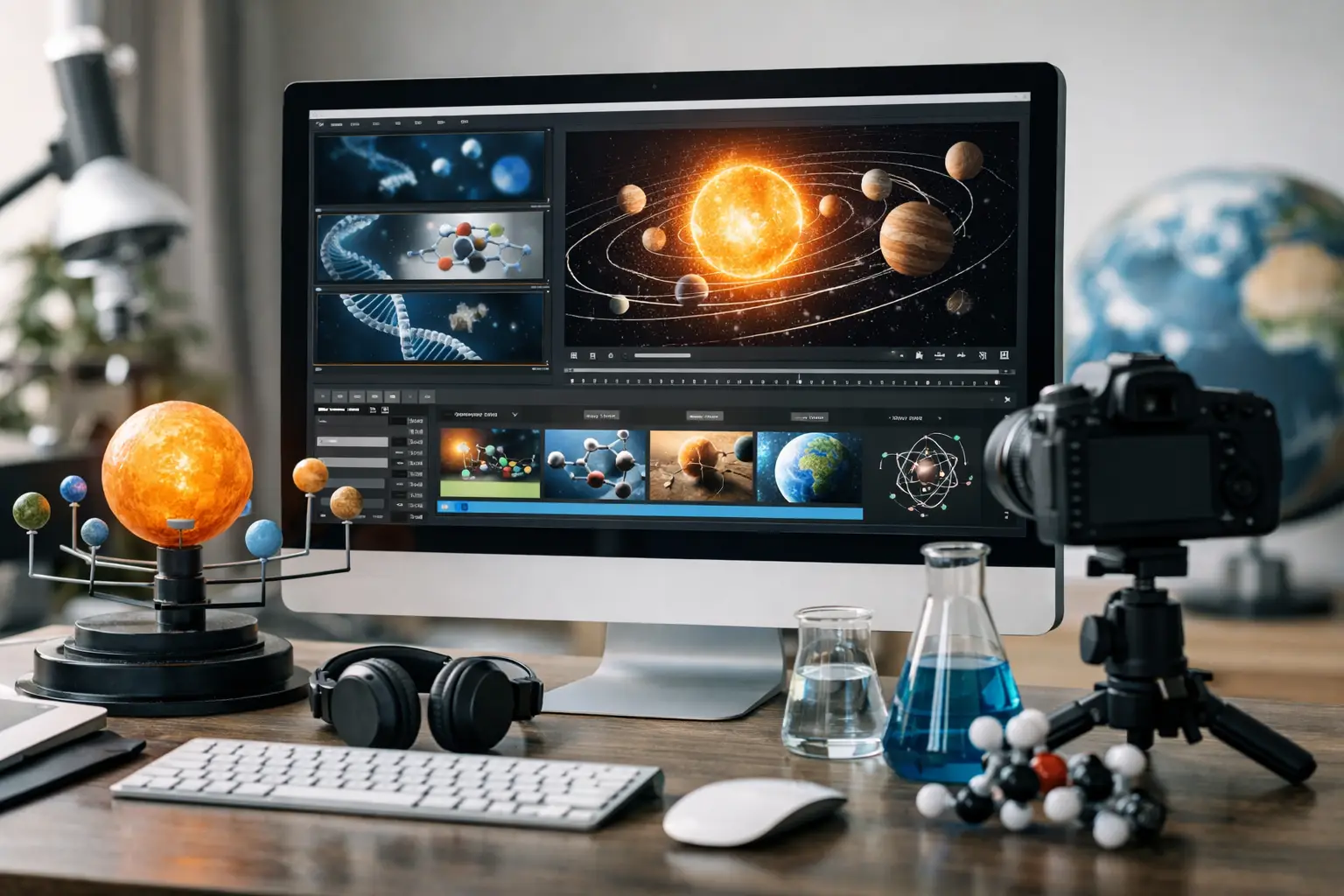
Next comes narration and visual direction. A professional voiceover sets the pace and credibility of the production, while a scene-by-scene storyboard prevents the video from becoming a static lecture. The visual package may combine space imagery, historical footage, diagrams, animated-style sequences, scientific illustrations, and text overlays depending on the topic. A video on plate tectonics needs different visual logic than a video on dark matter.
Then comes distribution. A strong production package includes a thumbnail concept, source references, and YouTube SEO metadata shaped around the audience's search behavior. This matters because science viewers may discover a video through curiosity-led recommendations, direct searches, or timely interest around a new discovery. The packaging has to earn the click without making claims the video cannot support.
Build videos around questions, not school subjects
“Physics” is a category. “What would happen if Earth stopped spinning?” is a video. The difference is crucial for reach.
Broad subjects are useful for planning a channel, but each upload needs a specific promise. The best science explainers make viewers feel that they will understand something surprising by the end. That promise can come from a mystery, a risk, a breakthrough, a thought experiment, or a familiar event with an unfamiliar explanation.
Instead of entering a vague topic such as “the human brain,” frame the production around a clear angle: Why does your brain create false memories? Could humans ever live without sleep? What happens inside the brain during anesthesia? These ideas give the script a natural beginning, middle, and payoff.
There is a trade-off. Highly dramatic topics can attract clicks, but they also create pressure to overstate the evidence. A title such as “Scientists Prove We Live in a Simulation” may bring short-term attention, but it can damage trust if the video presents speculation as fact. Long-term science channels grow by making the packaging exciting and the explanation disciplined.
A faster workflow for faceless science channels
The practical workflow should feel simple: choose a topic, generate the production assets, review the facts and creative direction, then publish. Automation handles the repetitive work so the creator can focus on judgment.
With DocuViralPro, a creator can enter a science topic and receive a fact-grounded script, professional narration, storyboard-based slideshow documentary, cinematic music direction, thumbnail, sources and citations, plus YouTube-focused metadata. That replaces a scattered stack of research documents, voice tools, stock searches, editors, and SEO checklists with one production flow.
The review step still matters. AI can accelerate the first draft, but science content benefits from a human final pass. Check that terminology matches the intended audience. Confirm dates, measurements, names, and causal claims. Make sure an analogy does not imply more certainty than the research supports. If your channel targets general viewers, remove jargon that slows comprehension. If it targets science enthusiasts, preserve the detail that makes the video worth watching.
This is not a reason to return to a fully manual workflow. It is a reason to use automation where it creates the most leverage: first drafts, structural pacing, narration, visual planning, and publishing assets. The creator remains responsible for the standard of the channel.
How to make generated science videos feel original
Automation increases output, but it should not make every upload feel interchangeable. Originality comes from editorial choices.
First, build recurring series rather than chasing random subjects. A space channel might run “Impossible Objects,” “The Physics of Everyday Life,” and “Signals From the Universe.” A biology channel could focus on “What Your Body Does Without You Noticing.” Series give viewers a reason to recognize the channel and return for the next episode.
Second, set a consistent audience level. Decide whether your videos are built for curious beginners, high-school learners, or viewers who already follow scientific news. Switching between extremes can confuse subscribers. You can cover complex topics without speaking like a textbook. Define difficult terms in motion, use examples, and keep the story moving forward.
Third, create a recognizable visual identity. Documentary-style science content does not need the same image treatment in every scene, but it should share a coherent color palette, music mood, narration style, and thumbnail approach. Consistency helps a growing channel look established before it has a large catalog.
Finally, use your analytics to choose the next topic. A high click-through rate with weak retention may mean the title made a promise the opening did not deliver. Strong retention with low impressions may point to weak packaging. If viewers rewatch a section or leave questions in comments, that is not just feedback - it is a roadmap for follow-up videos.
Scale output without lowering trust
Publishing more often helps YouTube channels learn faster. More uploads create more opportunities to test hooks, topics, thumbnails, and audience segments. But speed only works when the quality system stays intact.
For science content, that system means maintaining a clear distinction between observation, evidence, interpretation, and prediction. It means using citations where viewers can verify claims. It means avoiding medical, climate, and technology claims that turn uncertainty into certainty just to sound dramatic. In other words, engineer the production for virality, but protect the credibility that makes viewers subscribe.
A reliable science video library becomes an asset over time. Evergreen explainers about black holes, the immune system, evolution, electricity, or the ocean can continue earning views long after publication. Timely videos about launches, discoveries, and debates can bring new audiences into that library. The most effective channels combine both: searchable foundations and relevant new stories.
The opportunity is not to automate curiosity out of science content. It is to remove the production friction that keeps good ideas trapped in a notes app. When your workflow can turn a sharp question into a polished documentary package, you can spend more time choosing ideas worth watching and more time building a channel viewers trust.